Posts

The life and tragic death of lightkeeper Thomas King

Image
Slyne Head. Photograph by Simon Wall The King family was synonymous with Slyne Head for 130 years. It was they who held the contract to supply the two lighthouses at the northernmost point of Galway Bay probably from 1836 when the lights were first established until the 1960s, when helicopters took over the business of transporting food and mails and men to the tiny island.  It was Thomas King who, in 1852, was allegedly shamed by a lightkeeper into making the short but hazardous journey during a fully-blown storm, resulting in the deaths of seven men, including Thomas himself, his brother Festy and his son or nephew, John, not to mention the lightkeeper. Following Thomas' demise, the Ballast Board contract was taken over by his son John, who held the position for roughly fifty years. John seems to have been a remarkable man who, it is alleged, fathered roughly twenty children. One of the first of these was Thomas King, born in 1866 and named for his grandfather,  The uber-fer...

Mullaghmore lighthouse - was it ever built?

Image
  The above Failte Ireland photograph shows Mullaghmore Harbour in north county Sligo, a beautiful and peaceful spot very unfairly known to most people as the place where the IRA blew up Mountbatten's boat in 1979, killing Mountbatten and two children. I was only ever there the once when our own children were small and we spent a glorious. afternoon on the long, sandy, practically empty beach. It is apparently a favourite beach for surfers also, though I don't recall them at the time of our visit. Photo from buildingsofireland.ie There is no lighthouse at Mullaghmore, unless it is one only visible to members of the wizarding community, of which I am not a member. The pier, most sources say, was built between 1820 and 1840 by the local landowner, Lord Palmerston, an absentee landlord who later became Prime Minister of Great Britain twice. Evidently he was not well loved by his tenantry, though I doubt he lost a lot of sleep about it. Many of the local population were forced to f...

The case of the disappearing lightship

Image
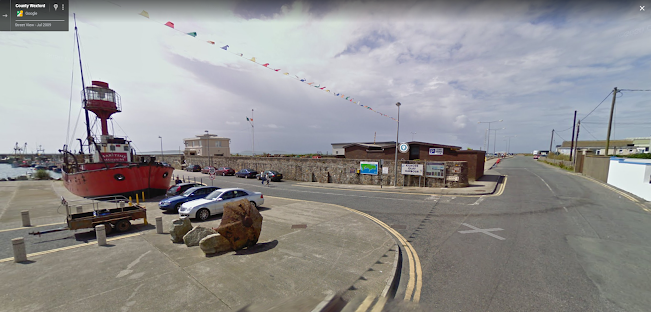
  This is the Irish lightship Guillemot, built in 1923 in its pride of place in the harbour at Kilmore Quay. This photo taken from Google Street View. Now watch what happens on Street View when you move ten yards down the road towards the junction: - The lightship has mysteriously turned into a set of picnic tables. Excellent recycling but how on earth did they do that? David Blaine? A hole in the space / time continuum? Is it done with mirrors? I need a pint.

The case of the Slyne Head photograph

Image
  (Photograph copyright Pauline Mickelsen) "What do you make of this photograph, Watson?" asked Holmes suddenly, thrusting the sepia rectangle into his friend's hand. As Holmes paced nervously around the study playing Whoa-oh-Black Betty on his Stradivarius, Watson turned the picture over, turned it back again, drew out a magnifying glass, examined the picture and handed it back. "Says 1905 on the back, Sherlock," he murmured. "Bunch of guys on a rock by the sea in 1905. Oh and there's a small boat too. Is that singular?" "Well, it's sure as shit not plural, Watson," replied the other, with a deprecating stare. "Is that all you could come up with?" "One of them seems to have a stomach ache as though something's lodged in his - what's that canal that runs from your throat to your arse?" "Alimentary, my dear Watson. Are you sure you're a doctor?" "Well, what do you make of it, clever-clog...

Balbriggan lighthouse, county Dublin

Image
I have no qualms about featuring Balbriggan lighthouse again. The sea lights, run by Irish lights, garner a lot of publicity (and rightly so) but the smaller harbour lights only really generate local interest. Balbriggan was once employed by Irish Lights but, on the introduction of Rockabill to the workforce in the 1860s, was tactfully informed that her job was no longer available but there was a position going as a harbour light, might suit a retired lighthouse. It is of course the second or third oldest working light on our coasts (after Hook Head and Poolbeg, though the latter was much altered in 1820) after being established in 1769, making it over a quarter of a millennium old, another reason to garner more kudos than it does.  Photograph by Eoghan Brady Many lighthouse enthusiasts will know of a book called "Bright Lights, White Water" by Bill Long published in 1993. For many years, it was my lighthouse bible and it still is in many ways, a mixture of lighthouse histor...

The MV Valonia

Image
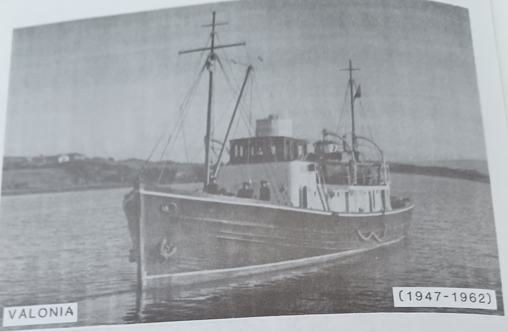
This, sadly, is the best picture I could come up with (from one of the early Beam magazines) of the MV Valonia , which served in Irish Lights from 1950. This diesel-engined motor vessel was purchased from Trinity House as a replacement for the Nabro , which had served as relief vessel for lighthouses on the Cork and Kerry coasts. Captain J. Oscar O'Hehir, formally Captain of the Granuaile   (the first one), was chosen to be her first skipper.  Other skippers during her ten-year tenure included Captain J. Coma, Captain Dermot E. Cormack, tragically drowned at Castletownbere in 1954, the exotically-named Captain Plato Harrison and Captain Herbert Greenlee. Four years before the Valonia was sold to David MacBrayne, the Hebridean ferry company, a mysterious incident occurred on board the vessel, in September 1958. The story was related in the Irish Lights staff magazine, date unknown. The first nine words of the report, in particular, made my hair stand on end. I am still trying...

Scotchport, county Mayo

Image
The lighthouse tender Rose in the storehouse at Scotchport (courtesy Sean Walker) Scotchport, on the Mullet peninsula in county Mayo, is kind of off the beaten track. It is also off the unbeaten track. There is so little there that it doesn't even appear on Google maps. Well, it does, but under the name " Wavesweeper Sea Adventures, " which may well be the Irish for Scotchport but is more likely the coastal location for a family tourism enterprise based in Belmullet. It isn't really a place that you would pass by accident. Coming from Belmullet, you go through the village of Corclough West and continue until you hit the coast. The road to your right leads to  Dún na mBó (where there is a blowhole)  and the Eagle Island viewing point. The road to the left passes Scotchport and curls back around to Termoncarragh Bird Reserve and graveyard, which, if either was your destination, would have been more easily accessible from Corclough West. The road to Scotchport Scotchpor...